





What Is a Clinical Trial Execution System and Why You Need One?
In This Article:
- What Is a Clinical Trial Execution System?
- The Difference Between Systems of Record and Systems of Action
- Core Architecture: Three Features That Define an Execution System
- Evaluating Execution Systems: A Buyer’s Checklist
- How Execution Systems Protect Study Integrity and Audit Trails
- FAQs
- References
|
Clinical trial execution systems convert detected risks into structured, verified actions across workflows, ensuring that issues are not only identified but resolved under defined governance controls.
Part 1 of this series established why that gap exists: the industry has built sophisticated visibility into trial performance, but the operational infrastructure to act on that visibility has not scaled at the same pace. The result is that deviations recur, amendments stall, costs compound, and audit trails fragment, not because teams are uninformed, but because no system governs what happens between the flag and the fix.
This article defines what execution systems are, how their architecture works in practice, and what to look for when evaluating one. It is written for clinical operations leaders and IT teams who are moving from recognizing the gap to making a decision about how to close it.
The Difference Between Systems of Record and Systems of Action
|
Systems of record and systems of action address fundamentally different operational problems. Understanding that distinction is what separates organizations that keep adding monitoring layers from those that close the execution loop.
A CTMS accurately captures enrollment milestones, site activation status, and protocol amendment history. An EDC accurately records data queries, discrepancies, and resolution flags. These systems do exactly what they are designed to do. The limitation is not their accuracy. It is their scope: they record what happened, and they stop there.
When a deviation is flagged, a CTMS can display it on a dashboard. It cannot route corrective actions, verify completion, or escalate delays. That gap still depends on manual coordination, which does not scale with trial complexity.
The comparison below highlights how these systems differ across essential operational dimensions.
| Dimension | Systems of Record (CTMS/EDC) | Systems of Action (Execution Layer) |
| Primary function | Capture, store, and retrieve trial data and milestone events | Translate data-driven signals into governed, cross-functional action pathways |
| Output produced | Records, status dashboards, and compliance reports | Verified, documented workflow completions with closed-loop audit trail |
| What it tracks | What happened and when it was recorded | What happened, what was triggered in response, and whether the action was confirmed complete |
| What it cannot do | Initiate, coordinate, or verify a corrective response without human intervention | Replace clinical judgment or the expert oversight that governs every action pathway |
| Example tools | Veeva Vault CTMS, Medidata Rave EDC, Oracle Clinical One, Cognizant TrialSpark | AI Workforce for Clinical Trials (Maxis AI) |
The table above reflects the complementary roles of these systems. CTMS and EDC platforms are designed as systems of record, providing accurate, reliable visibility into trial operations.
The opportunity lies in extending this foundation with an execution layer that converts that visibility into coordinated, verifiable action. Together, these layers ensure that insight and execution operate in alignment.
Core Architecture: Essential Features of an Execution Layer
Every tool that claims to be an execution system is not necessarily one. There are three characteristics of architecture that define clinical trial workflow orchestration in practice. A system that lacks all three is not bridging the execution gap; it is simply describing it.
1. Automated Workflow Orchestration
Automated workflow orchestration means the system moves a detected signal through a complete, multi-step response pathway without requiring a human to initiate each individual step. This is what clinical trial workflow orchestration means in operational terms, and it is meaningfully different from point-to-point automation.
Point-to-point automation connects two systems in a fixed sequence: if A happens, trigger B. That works for isolated tasks. It breaks the moment a response requires coordinating three or four functions simultaneously. Consider a typical amendment delay scenario:
- The CTMS flags that Site 14 has not acknowledged a substantial amendment 28 days after issue
- An execution system routes an escalation to the assigned CRO project manager with a 72-hour response protocol
- Simultaneously, it notifies the sponsor’s regulatory contact that the amendment timeline is at risk
- It logs the escalation, timestamps the acknowledgment, and tracks response at the site level
- If the 72-hour window closes without a confirmed response, the system escalates again to the next defined owner
None of these steps require a human to notice the flag and decide what to do. The orchestration layer handles the routing, the timing, and the escalation logic. This is exactly what workflow orchestration for clinical trials enables, not automation of tasks but management of resolution cycles.
2. Closed-Loop Verification
Closed-loop verification functions as the execution memory of the process. The majority of processes end with the trigger; there will be an alarm raised, someone will get assigned with a task, and it will be recorded by the system. This is just notification and not verification.
Closed-loop verification will go further to ensure that the task has been done correctly on time by the right team in the right location.
|
This distinction matters more at inspection than at any other point in the trial lifecycle. A regulator reviewing a recurring deviation pattern will ask not just when the correction was issued, but when it was confirmed as implemented, at which sites, by whom, and what the system did when implementation was not confirmed. Closed-loop verification is the only mechanism that produces those answers without manual reconstruction.
3. Unified Oversight Across the Trial Network
Unified oversight connects sponsor, CRO, and site activity within a single governed execution record. When oversight is fragmented across multiple systems, coordination gaps remain hidden until they appear as delays.
Unified oversight does not replace existing systems. It ensures a shared, traceable record of execution across all stakeholders:
- What was triggered
- What actions were taken
- What was verified as complete
Fragmented oversight creates an accountability gap. Without a unified view, there is no reliable way to confirm that actions were completed consistently across all sites and stakeholders.
ICH E6(R3) [2] reinforces that sponsors remain accountable even when work is delegated to CROs. Unified oversight operationalizes this accountability operational, enabling inspection-ready evidence without relying on reconstructed records.
Evaluating Execution Systems: A Buyer’s Checklist
When evaluating vendors, the key question is how well the system supports clinical trial workflow orchestration after a signal is generated, how it integrates with existing infrastructure, and what governance evidence it produces.
Use the checklist below to assess whether a system enables true execution or simply improves visibility:
✔ Orchestrates complete response workflows
The system should move beyond alerts and route signals through a governed, multi-step response without manual initiation.
✔ Integrates with existing CTMS and EDC systems
The architecture should work alongside current systems, with the ability to read and write data directly, without requiring parallel environments.
✔ Provides closed-loop verification with automated escalation
The system should confirm that actions are completed, not just initiated, and automatically escalate when timelines are missed, with full timestamped traceability.
✔ Supports clinical trial workflow orchestration across all stakeholders
The system should adapt to different operating models, sponsor-led, CRO-led, or hybrid, without relying on fixed workflow templates.
✔ Generates a complete, inspection-ready audit trail
The audit trail should capture the full lifecycle from signal to verified completion, including escalation steps, acknowledgments, and final outcomes.
✔ Enables governed human oversight with full traceability
Validation checkpoints, approvals, and overrides should be clearly defined and logged with the same level of traceability as system-driven actions.
|
👉 If you want to understand how to move from evaluation to actual implementation, explore the next step in this series:
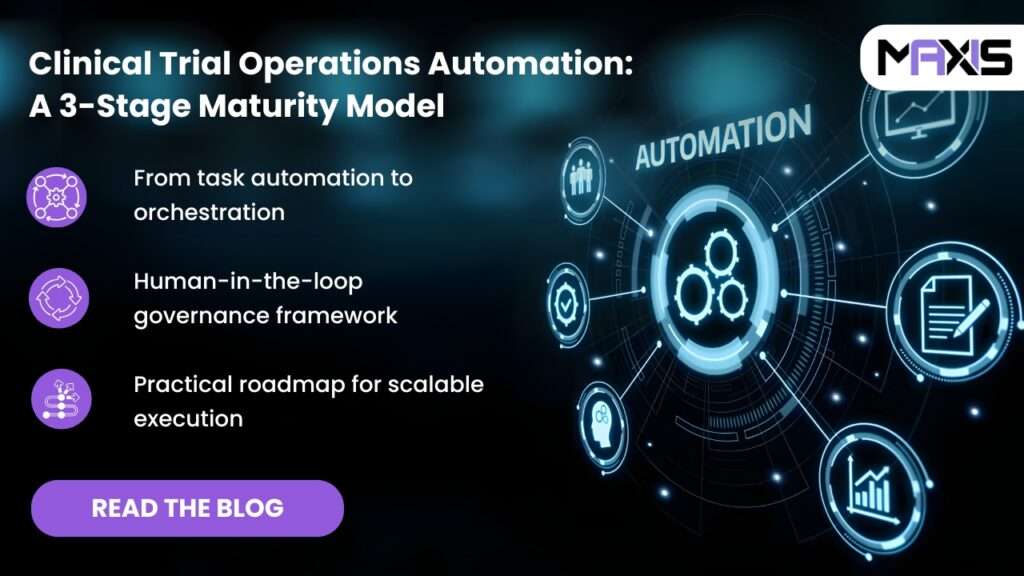
Clinical Trials Operation Automation: A 3-Stage Maturity Model
How Execution Systems Protect Study Integrity and Audit Trails
Quick Answer: How do execution systems impact study integrity?
Execution systems ensure that corrective actions are completed, validated, and documented, creating an audit-ready record that supports regulatory compliance and data reliability.
Data quality is usually seen as a failure in study integrity, but in reality, these are also execution consistency failures, a point that is finally being considered in regulations.
The FDA’s December 2024 draft guidance on protocol deviations [3] emphasizes root cause resolution and consistency in implementation over counting deviations. This can’t be achieved through monitoring; it requires a governance system for corrections and documentation of compliance.
What the Audit Trail Gap Looks Like in Practice
In manually coordinated trials, audit trails capture detection well but often miss what happens after corrective actions are issued. This is where the gaps have been observed
What is typically recorded:
- When a deviation was flagged
- Which monitoring visit identified it
- The corrective action plan submitted
What is often missing:
- Whether the action was implemented at the site
- When it was acknowledged
- Whether completion was confirmed or assumed
This gap between issuance and confirmed implementation is where regulatory scrutiny focuses. If implementation cannot be proven, it is treated as incomplete, and the burden of proof must come from the trial record, not reconstructed communication.
How Execution Systems Close the Integrity Gap
Execution systems close the integrity gap by embedding corrective actions into governed workflows that are automatically tracked, verified, and recorded in real time.
When execution systems govern the corrective action process, the audit trail is produced as a byproduct of execution rather than as a reconstruction after the fact. Every action pathway generates a timestamped, sequential record:
- Signal detected and classified (deviation type, site, study day)
- Corrective action workflow triggered and routed to the defined owner
- Owner acknowledgment logged with timestamp
- Implementation deadline set and tracked by the system
- Closed-loop verification confirmed or escalation triggered on non-response
- Outcome recorded with site-level attribution and reviewer sign-off
That record is inspection-ready without manual preparation. It does not require retrieving emails, cross-referencing monitoring visit notes, or reconstructing a timeline from CTMS entries made by different users at different times. The execution system produced it as part of the operational workflow.
This is also what makes execution systems directly relevant to ICH E6(R3)’s [2] reinforced emphasis on sponsor oversight in outsourced environments. When a CRO manages site-level corrective actions on behalf of a sponsor, the sponsor’s ability to demonstrate oversight depends on having a complete, traceable record of what the CRO did and when. An execution system that governs those workflows provides that record structurally, not retrospectively.
This is the structural shift Getz and Kaitin called for in their Applied Clinical Trials analysis — read the full article here: https://www.appliedclinicaltrialsonline.com/view/recognizing-addressing-execution-translation-clinical-trials
Where the Maxis AI Workforce Fits in the Execution Architecture
The clinical trial execution system category is now being implemented through supervised, governed execution layers that sit between systems of record and operational outcomes.
Maxis AI represents one such implementation, structured as an AI Workforce that executes defined clinical workflows under human oversight, with audit traceability and controlled validation checkpoints embedded throughout.
It integrates with existing CTMS, EDC, and clinical data environments, enabling execution across workflows such as study startup, enrollment operations, data resolution, and deviation management without requiring system replacement.
This approach shifts execution from manual coordination to governed, repeatable workflows, allowing organizations to scale execution capacity while maintaining oversight and regulatory alignment.
|
Frequently Asked Questions (FAQs)
What is the difference between a CTMS and a clinical trial execution system?
A CTMS is a system of record that tracks study data and milestones. A clinical trial execution system is a system of action that routes signals into governed workflows, verifies completion, and produces an auditable record. One records what happened, the other ensures it is resolved.
Can an execution system work with existing EDC and CTMS platforms?
Yes, execution systems integrate with existing infrastructure as a supervised execution layer. They read signals from CTMS and EDC systems and write back verified action records without requiring system replacement.
What does closed-loop verification mean in a clinical trial context?
Closed-loop verification confirms that a corrective action was completed, not just initiated. It tracks acknowledgment, implementation, and completion, and automatically escalates if timelines are missed.
How does an execution system support audit trail requirements?
Execution systems generate a complete, time-stamped record of actions from signal to verified completion. This includes routing, acknowledgment, implementation, and escalation, creating inspection-ready audit trails.
Is a clinical trial execution system the same as a risk-based monitoring platform?
No. Risk-based monitoring identifies and prioritizes risks. Execution systems govern the response, determining who acts, in what sequence, and ensuring actions are completed and verified.
References:
[1] Getz, K., and Kaitin, K.I. (2026). Recognizing and Addressing the Execution Translation Gap in Clinical Trials. Applied Clinical Trials. https://www.appliedclinicaltrialsonline.com/view/recognizing-addressing-execution-translation-clinical-trials
[2] International Council for Harmonisation. (2023). ICH E6(R3): Guideline for Good Clinical Practice. https://www.ich.org/page/efficacy-guidelines
[3] U.S. Food and Drug Administration. (2024, December). Draft Guidance: Protocol Deviations in Clinical Investigations. https://www.fda.gov/regulatory-information/search-fda-guidance-documents