





Clinical Trial Execution Gap: Why It’s Now a Cost, Timeline, and Compliance Problem
In This Article:
- When Execution Becomes the Constraint
- Why Manual Coordination Cannot Scale and How it Breaks
- Why the Gap Is a Cost Problem
- Why the Gap Is a Timeline Problem
- Why the Gap Is a Compliance Problem
- From Execution Gaps to Execution Systems
- Conclusion
- FAQs
- References
When Execution Becomes the Constraint
The industry has never had better tools for identifying problems. Over the last decade, heavy investment in real-time dashboards, risk-based monitoring, and centralized data review has transformed visibility. Teams can now spot risks with more precision than any previous generation.
Clinical trial execution becomes a constraint when we still see trial timelines slipping. Protocol deviations are being repeated. Trial costs compounding. The failure isn’t a lack of data; it is a structural breakdown in how that data is converted into coordinated, timely action. We have mastered detection, but the system of execution remains broken.
Getz and Kaitin characterize this as a third translational barrier in drug development — distinct from scientific gaps, and more operationally damaging than either [1]. It is not a knowledge problem. It is a clinical trial execution problem.
👉 Read the full Tufts CSDD perspective in Applied Clinical Trials →
💡 What is the Execution Translation Gap?
The Execution Translation Gap is the systemic failure to convert well-identified problems into coordinated, timely, and effective action. — Getz & Kaitin, Tufts CSDD, Applied Clinical Trials, April 2026
Why Manual Coordination Cannot Scale and How it Breaks
Manual coordination cannot scale clinical trials because with increasing trials a proportionate increase in headcount is required to manage them. This increases trial operation costs.
In the past, manual coordination was relying on follow-up calls, endless email chains, and informal escalations. But as protocol complexity grows and site networks expand, the human bandwidth required to hold cross-functional execution together now exceeds what any team can sustain. This isn’t a process failure; it is a fundamental capacity failure.
We have frequently observed these reasons as the prime ones where manual coordination disrupts the clinical trial process.
Reason 1: Instructions Don’t Reach Sites Consistently
In a manual coordination model, a corrective decision made at the sponsor level has to travel through a CRO layer and then down to individual sites, each with their own local teams, timelines, and interpretations. There is no governed mechanism to ensure that the decision arrives, is understood, and is acted upon uniformly.
In practice, this means:
- The same protocol amendment gets implemented differently across sites
- A corrective action applied at one site never reaches another
- Instructions are acknowledged but not followed through, because nothing in the system verifies, they were
Reason 2: A Single Delay Cascades Across the Study
Clinical trial workflows are sequentially dependent. When one handoff breaks, the downstream impact compounds before anyone catches it.
Common cascade triggers:
- A delayed amendment stalls site activation until implementation is complete
- A stalled data query pushes database lock and delays submission readiness
- A slow vendor reconciliation extends the study timeline for everyone downstream
By the time the delay appears in a status report, recovery is already expensive and rarely brings the study back on schedule.
Reason 3: There Is No System to Confirm That Actions Were Actually Taken
Manual coordination lacks an execution memory. An email is sent, a phone call is made, corrective action is recorded, but was it done at the right place? At the right time? In the right way? Such questions remain unasked.
This is why the same deviation types recur across studies:
- Interventions are initiated but not sustained
- Issues resolved at one site reappear at another
- The loop is never closed because no system was built to close it
Why Current Approaches Cannot Close the Execution Gap
Despite advancements in analytics, monitoring, and point automation, the execution gap persists.
The reason is structural.
- Analytics platforms detect issues but do not resolve them
- Dashboards visualize risk but do not trigger coordinated action
- Point AI tools automate tasks but do not manage cross-functional dependencies
Execution remains dependent on manual coordination—emails, follow-ups, and local ownership.
As a result, the system can see problems clearly but cannot act on them consistently.
This is why the execution gap continues to impact cost, timelines, and compliance – despite better visibility.
Why Execution Gap Is a Cost Problem
Execution gap becomes a cost problem because delays do not occur in isolation, they compound across interconnected workflows while operational costs continue to accrue daily.
Even when progress stalls, trials continue to run, resources remain engaged, and inefficiencies accumulate across functions. Over time, this shifts cost from planned to uncontrolled.
The Financial Reality
The cost of a Phase III trial is estimated at $56,000 per day [1], which continues to accrue even when the process is delayed.
As noted by Kenneth Getz and Joseph Kaitin in Applied Clinical Trials [1], a 90-day delay alone can add $5M+ in direct costs excluding internal overhead.
How Existing Systems Fuel Hidden Costs
Analytics platforms surface warning signs; traditional systems work in a linear manner with trials proportionate to headcount and point AI solutions take care of siloed processes. What each of them lack is the “action layer” needed to stop cost compounding. These existing systems fuel hidden costs when Execution Risk Indicators (ERIs) – the metrics that signal operational friction are detected but not resolved.
Let us understand the triggers which fuel hidden costs.
- Observation vs. Orchestration: Tools like CTMS and dashboards track what has happened; they don’t orchestrate what needs to happen next. This leads to trial delays impacting cost as these gaps are to be resolved through manual follow-ups.
- The “Detection Tax”: Identifying a cost driver and resolving it are two different things. Without automated coordination, flagging an ERI simply creates a larger backlog of manual tasks that overstretched teams cannot sustain.
- The Loop-Closing Failure: When interventions aren’t triggered automatically across vendors, ERIs such as recurring deviations turn into compounding financial burdens. A single oversight becomes a multi-million-dollar delay because the system couldn’t “close the loop.”
This compounding effect becomes clearer when viewed at the workflow level:
Where Costs Compound
| Execution Failure | Direct Cost Driver | Compounding Effect |
| 90-day delay | $56K/day × 90 = $5M+ [1] | Deferred revenue; portfolio-level impact |
| Amendment backlog | Site holds on affected workflows | Enrollment delay; start-up extension |
| Site underperformance | Backup site activation costs | Overall study duration increase |
| Deviation rework | Monitoring escalation; additional oversight | Resource drain; audit burden |
| Slow database lock | Vendor reconciliation overhead | Delayed submission readiness |
📊 What is the financial impact of a delayed clinical trial?
Execution delays add significant direct costs to any trial phase and the longer the delay, the more those costs compound across stalled workflows, extended site activity, and deferred milestones. For example: A 90-day delay at the Phase III stage alone can exceed $5 million in direct costs.
👉 Related: Beyond Detection: Why Clinical Trials Need Execution Systems →
Why Execution Gap Is a Timeline Problem
Execution Gap becomes a timeline problem because current systems are designed to monitor what has happened—not coordinate what needs to happen next.
As a result, delays are not only frequent—they become unpredictable, driven by unsynchronized workflows, slow handoffs, and inconsistent execution across stakeholders.
The Reality in Numbers
Research from Tufts CSDD, published in Applied Clinical Trials, confirms a systemic slowdown:
- Start-up cycles: Protocol approval to FPFV has extended by 30–45% since 2015 [1].
- Amendment lag: Implementation now averages 260 days—a 154% increase since 2010 [1].
- Deviation volume: Phase III deviations have risen 56% in five years (from 189 to 296) [1].
How Existing Systems Delay Timelines
While visibility has improved, legacy systems remain in passive repositories. They record that a milestone was missed, but they lack the AI-enabled execution layer required to prevent the miss.
- Record vs. Action: The CTMS is a system of record because it documents events that have occurred rather than actions that need to be taken. If there is a failure to reach a milestone, then the reaction remains dependent upon a human noticing the warning sign and taking action.
- The Point Solution Gap: Many AI tools automate isolated tasks but offer no end-to-end accountability. Without a system to orchestrate workflow dependencies, time-sensitive transitions are left too late for manual follow-ups.
- The Cascade Effect: Because legacy tools cannot trigger proactive responses, a single bottleneck quickly compounds into a trial-wide slip. This is a framework failure resulting in scaling issues, where human teams cannot keep up with the volume of required interventions.
💡 Why doesn’t better monitoring fix trial delays?
Because monitoring stops at detection — it doesn’t trigger the coordinated response needed to resolve the problem. The actual delay builds at the handoff: when a flagged issue has to travel through functions, CROs, and sites before anyone acts on it, the gap between detection and resolution is where time is lost.
Why Execution Gap Is a Compliance Problem
Execution Gap becomes a compliance problem when corrective actions are not consistently applied across sites, leading to recurring deviations, fragmented audit trails, and variation in protocol adherence.
Compliance frameworks define what should happen, but execution determines whether it actually happens.
The Data
- Deviation Surge: Phase III deviations rose 56% in 5 years—not because monitoring failed, but because the response to monitoring didn’t produce lasting change.
- The SDV Trap: Despite widespread RBQM adoption, many teams still perform 100% SDV, contradicting the model’s intent.
This represents strategic intent without operational follow-through, creating a measurable compliance risk that legacy systems cannot mitigate.
How Existing Systems Compromise Compliance
Inconsistent execution creates protocol variation across sites—and that variation is exactly what regulators are trained to identify.
- Systemic Failure vs. One-off Fixes: Recurring deviation patterns signal that root causes aren’t being addressed systemically [1]. Analytics platforms might see the pattern, but they lack the governed action layer required to stop it.
- Audit Trail Fragmentation: Relying on manual follow-ups (emails/calls) creates fragmented audit trails. This makes it nearly impossible to demonstrate a clear, chronological history of when and how corrective actions were taken during a submission review [2].
- Credibility Gaps: When RBQM claims don’t match actual monitoring behavior, it undermines the credibility of the entire quality system [2]. Without an orchestration layer to enforce consistent behavior, the “risk-based” approach exists only on paper.
📊 How does inconsistent execution create compliance risk?
When the same corrective action is applied at one site but not others, protocol conduct varies across the network. That variation accumulates into fragmented audit trails, recurring deviation patterns, and quality claims that don’t match actual monitoring behaviour — all of which give regulators grounds to question the integrity of the trial data at submission.
👉 Related: Operationalizing Clinical Trial Execution: From Gaps to Systems →
From Execution Gaps to Execution Systems
Understanding the gap is only the first step. Closing it requires a shift in how execution itself is structured, moving from manual coordination to system-driven execution.
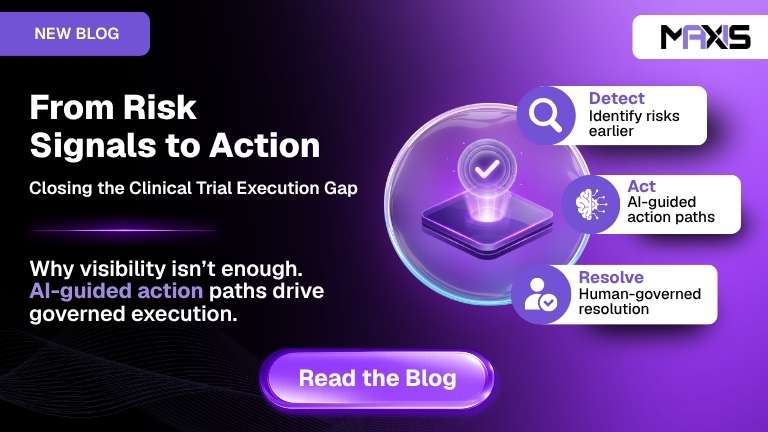
Most trials still rely on reactive, manual responses to data alerts. But at today’s volume and protocol burden, the industry needs a supervised execution layer that works alongside human teams to perform defined workflows. This model, often referred to as an AI Workforce, is designed to maintain cross-functional coordination and produce governed action, ensuring that “detection” actually leads to “resolution.”
How the AI Workforce Model Operates
In practice, this model operates through a structured execution layer that works alongside human teams, ensuring that identified issues are translated into coordinated action across the trial ecosystem.
An AI Workforce does not replace human expertise; it orchestrates execution across systems while experts supervise, validate, and intervene where required.
This execution layer operates through a few core mechanisms:
- Converts Signals into Governed Action Paths – When a deviation threshold is crossed or a site falls behind, the model routes the issue to the correct cross-functional owners with defined response protocols and timelines. It moves the process from a passive alert to a governed action [1].
- Orchestrates Across Functional Silos – Unlike point AI solutions that automate specific, discrete tasks, the AI Workforce accounts for whichever combination of sponsors, CROs, and sites is running the trial, maintaining execution continuity at the handoff points between people, where delays most often occur.
- Proactively Operationalizes Execution Risk Indicators (ERIs) – By establishing thresholds for amendment timelines and data reconciliation, the model triggers supervised execution the moment an ERI is flagged, preventing minor delays from compounding into missed milestones [1].
- Scales Throughput Without Proportional Headcount: By performing structured, repeatable workflows such as data query resolution and enrollment coordination, this model increases operational capacity. This allows organizations to scale trial volume without the linear cost of traditional resource expansion.
This is the type of operating layer now emerging in clinical trials. Platforms like Maxis AI have built this model as an AI Workforce designed to enable governed execution across complex, regulated workflows.
💡 How does an AI workforce for clinical trials work?
The AI Workforce acts as a supervised execution layer — performing defined clinical workflows under human oversight, integrated within existing systems. It converts detected signals into governed actions, coordinates across the sponsor–CRO–site chain, and operationalizes execution metrics before delays compound. Humans remain in control; the AI Workforce handles the orchestration that manual coordination cannot sustain at scale.
Regulatory frameworks reinforce this direction. ICH E6(R3) [2] emphasizes proactive risk management and sponsor oversight. ICH E8(R1) [3] ties execution to critical-to-quality design. The FDA’s December 2024 draft guidance [4] calls for structured root cause analysis and systemic learning — exactly what governed execution delivers.
👉 Read Part 2: Beyond Detection: Why Clinical Trials Need Execution Systems →
Conclusion: Closing the Gap
Clinical trials are no longer constrained by how effectively they can detect issues, but by how reliably they can act on them. The recurring challenges in cost, timelines, and compliance all point to the same structural limitation—execution has not scaled with complexity.
Closing this gap requires more than incremental improvement. It represents a shift from manual, coordination-driven models to system-driven execution.
Organizations that make this shift will not only improve operational efficiency, but also gain stronger control over timelines, costs, and regulatory outcomes.
This is not an optimization. It is a change in how clinical trials are executed.
📌 KEY TAKEAWAY
Insight is necessary. It is not sufficient. Clinical trial execution must be coordinated, scalable, and system-driven.
👉 Ready to close your execution gap?
Stop letting trial insights stall in your inbox. Discover how the Maxis AI Workforce provides the governed action layer your trial needs to stay on track.
► [Explore the AI Workforce Model]
Continue reading:
Part 2 → Beyond Detection: Why Clinical Trials Need Execution Systems →
Part 3 → Operationalizing Clinical Trial Execution: From Gaps to Systems →
Frequently Asked Questions (FAQs)
- What is the execution gap in clinical trials?
It is the failure to turn data insights into timely action. While dashboards detect problems, the manual process of resolving them is where timelines and budgets slip. - Why can’t manual coordination in clinical trials scale with modern protocol complexity?
Manual follow-ups can’t keep pace with modern trial complexity. The human bandwidth required eventually exceeds team capacity, leading to systemic delays. - How does an AI Workforce differ from CTMS or analytics tools?
A CTMS records what happened; an AI Workforce orchestrates what happens next. It adds an “action layer” to existing tools to ensure resolutions occur. - How do Execution Risk Indicators (ERIs) improve trial outcomes?
ERIs measure the speed of operational responses. Monitoring these allows an AI Workforce to trigger interventions early, preventing small delays from compounding. - Does an AI Workforce replace humans role?
No. It automates repetitive orchestration and tracking, acting as a force multiplier so human experts can focus on high-level strategy and compliance.
References:
- Getz, K., & Kaitin, K.I. (2026). Recognizing and Addressing the Execution Translation Gap in Clinical Trials. Applied Clinical Trials. https://www.appliedclinicaltrialsonline.com/view/recognizing-addressing-execution-translation-clinical-trials
- International Council for Harmonisation. (2023). ICH E6(R3): Guideline for Good Clinical Practice. https://www.ich.org/page/efficacy-guidelines
- International Council for Harmonisation. (2021). ICH E8(R1): General Considerations for Clinical Studies. https://www.ich.org/page/efficacy-guidelines
- U.S. Food and Drug Administration. (2024, December). Draft Guidance: Protocol Deviations in Clinical Investigations. https://www.fda.gov/regulatory-information/search-fda-guidance-documents